Kokrajhar Museum

Author: moikikorim

Ethnographic CollectionFishing and Hunting Implements

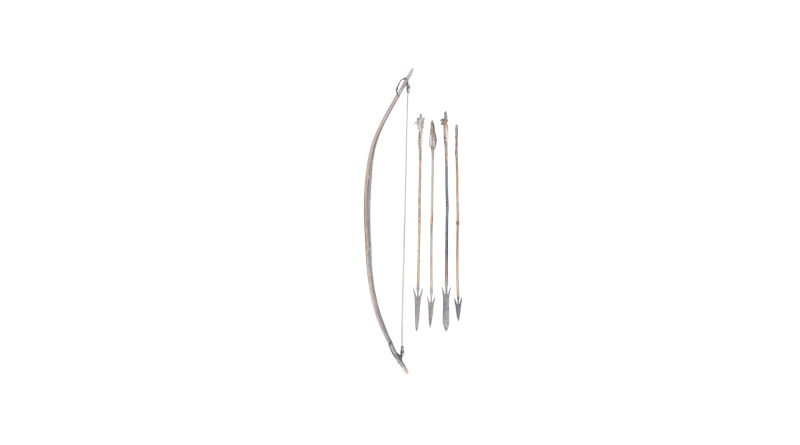
Bow and arrows

The bow and arrow is an age-old hunting implement. The bow is the elastic launching device and the arrows are long projectiles having a pointed tip. These are mostly made of split bamboos and used by the most of the ethnic communities for chasing and hunting animals like birds, rabbits, deer, porcupine, boars etc. A flexible and sturdy bamboo is selected which can be bend up to an arc. A string prepared of the upper skin of young bamboo plant with two notches on both sides is tied to the two limbs of the bow with small chords. The chords are made of jute. The bamboo slits used for making the arrow are straightened by wrapping them in taro (Colocasia esculenta) or sal (Shorea robusta) leaves and heating them slowly over fire. On one end of the shaft, an iron tip is notched whereas on the other end, a pile of uniformly trimmed feathers (mostly of eagle/vulture/pigeon) is tied or stuck into small gouges made on the surface of the bamboo. In earlier days it was used as a weapon for defense against intruders and even dangerous animals, now its usage is limited to simple hunting activities.

Read More
Ethnographic CollectionFishing and Hunting Implements

Fishing Net

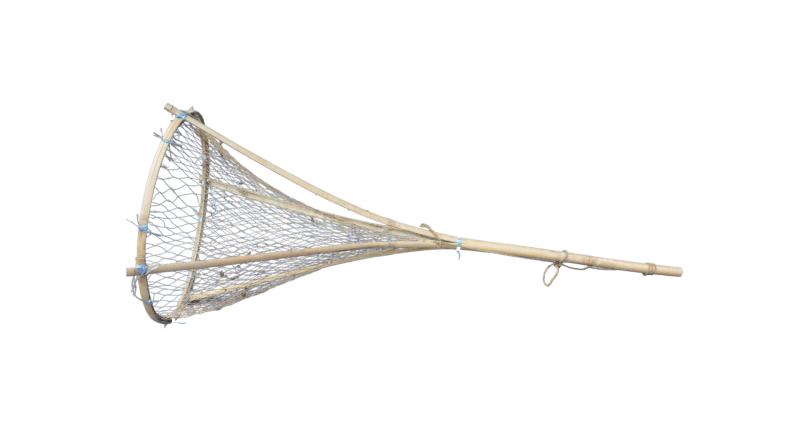
Je is a common implement used for fishing by the Bodo community. Chagje is used to fish small to big fishes in rivers, lakes, pond or the muddy water. It is made of nylon and plastic fiber or strings, braided in very intricate grid like pattern. A bamboo tube is split into four parts up to middle portion and a circular bamboo ring is then attached at the end of the split tube. The Je is then attached on the ring up to the mid of the stick. The use of this kind of fishing net is common to many communities of Assam.

Read More
Ethnographic CollectionFishing and Hunting Implements

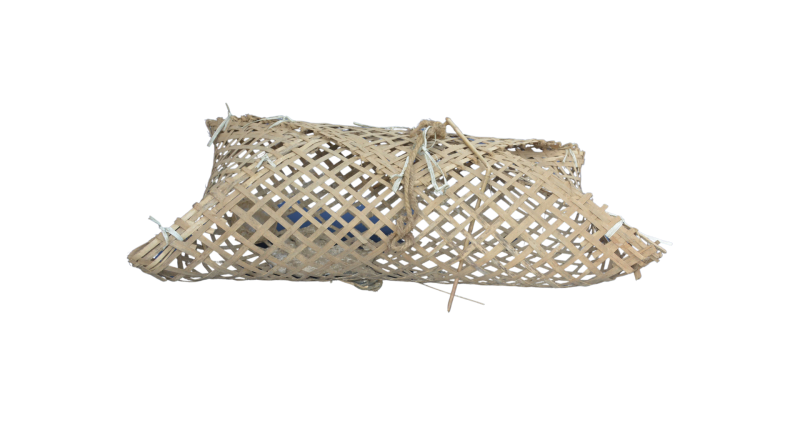
Fish container

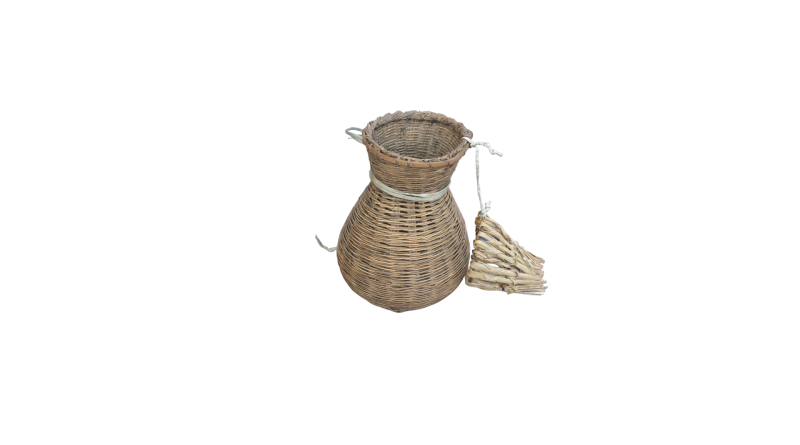
Khobai is fishing equipment which is used to store fish while fishing. The pitcher shaped container is made of bamboo, and sometime cane is also used to tie the knots. A bamboo lid is tied with the help of a rope. In the neck of the Khobai, a jute rope or cane wire is connected which is used to tie on the waist of the fishermen to keep the catches during the fishing operations. The tapering shape in the neck portion of the object prevents the caught fish coming out.

Read More
Arms and ArmourEthnographic Collection

Machete

Bashpate Khukuri, also known as the Majaulo Khukuri, is a type of machete of the Nepali community that is popularly used in modern day. The term Bashpate is an amalgamation of two words ‘Bash’ which means bamboo and ‘Pate’ means leaf. Hence the word Bashpate means the leaf of a bamboo tree which mirrors the shape of the Khukuri. Due to its broader profile it is heavier but more effective.

Read More
Arms and ArmourEthnographic Collection

Machete

Budune Khukuri is a type of small machete having a broad blade. Due to its heavier size, it is much more suitable for chopping activities in comparison to other blade types. The longer version of this blade was widely used in the Anglo-Nepal war fought in 1814-16. It is of broad shape having a broad belly, which gives out a beautiful form with compressing power at the tip of the blade. Spring steel is used to make the blade of khukuri, while brass or aluminum metal is used to make the handle of the weapon. The scabbard is generally made from wood or metal which is then covered with animal skin.

Read More
Don`t copy text!